
70,000+ Stock Buffer
Extensive warehousing in Hadsten (Denmark) and Ningbo (China) eliminates production downtime and protects your OEM delivery schedules from supply chain disruption.
As international environmental legislation tightens and industrial power tariffs escalate, procuring IE4 electric motors has transitioned from a sustainability preference to a fiscal necessity. Designed for global OEMs, plant procurement managers, and marine engineers, this guide examines the technical architecture, total cost of ownership (TCO) payback math, regulatory compliance mandates, and advanced integration strategies of IE4 Super Premium Efficiency motors.
Electric motor systems account for approximately 70% of all electrical energy consumed across global industrial manufacturing and marine process plants. Under standard IEC 60034-30-1 definitions, the IE4 (Super Premium Efficiency) class represents a substantial technological jump over standard IE3 designs, delivering a 15% to 20% reduction in thermal energy dissipation and electrical losses.
For global procurement executives evaluating industrial equipment, motor efficiency is not simply a label—it dictates lifetime operational expenditure (OpEx). Over a typical 15-year operational lifecycle for a continuous-duty motor (S1 duty), the initial purchase price accounts for only 2% to 3% of total lifecycle cost, while electrical power consumption accounts for over 95%. Transitioning from IE2 or IE3 units to high-efficiency IE4 electric motors directly suppresses Levelized Cost of Energy (LCOE) while meeting strict global decarbonization standards such as European Union Ecodesign Regulation (EU) 2019/1781 and International Maritime Organization (IMO) carbon intensity indicators (CII).
Because IE4 electric motors experience dramatically lower internal $I^2R$ stator copper losses, rotor iron losses, and stray load losses, their operating temperatures are significantly lower than standard motors. According to the Arrhenius rule in electrical insulation life expectancy, running a winding 10°C cooler doubles the thermal life of the insulation system (Class H insulation operating with Class B temperature rise margin). Consequently, Hoyer IE4 motors deliver extended MTBF (Mean Time Between Failures) and enhanced reliability during voltage fluctuations or heavy partial loads.
Hoyer Motors provides a comprehensive range of IE4 Super Premium Efficiency low-voltage motors engineered for extreme industrial and marine duty cycles. Designed with high-grade cold-rolled magnetic silicon steel laminations and optimized slot geometries, our motors seamlessly fit standard IEC frame dimensions (IEC 80 to IEC 355) to support effortless OEM replacement and system integration.
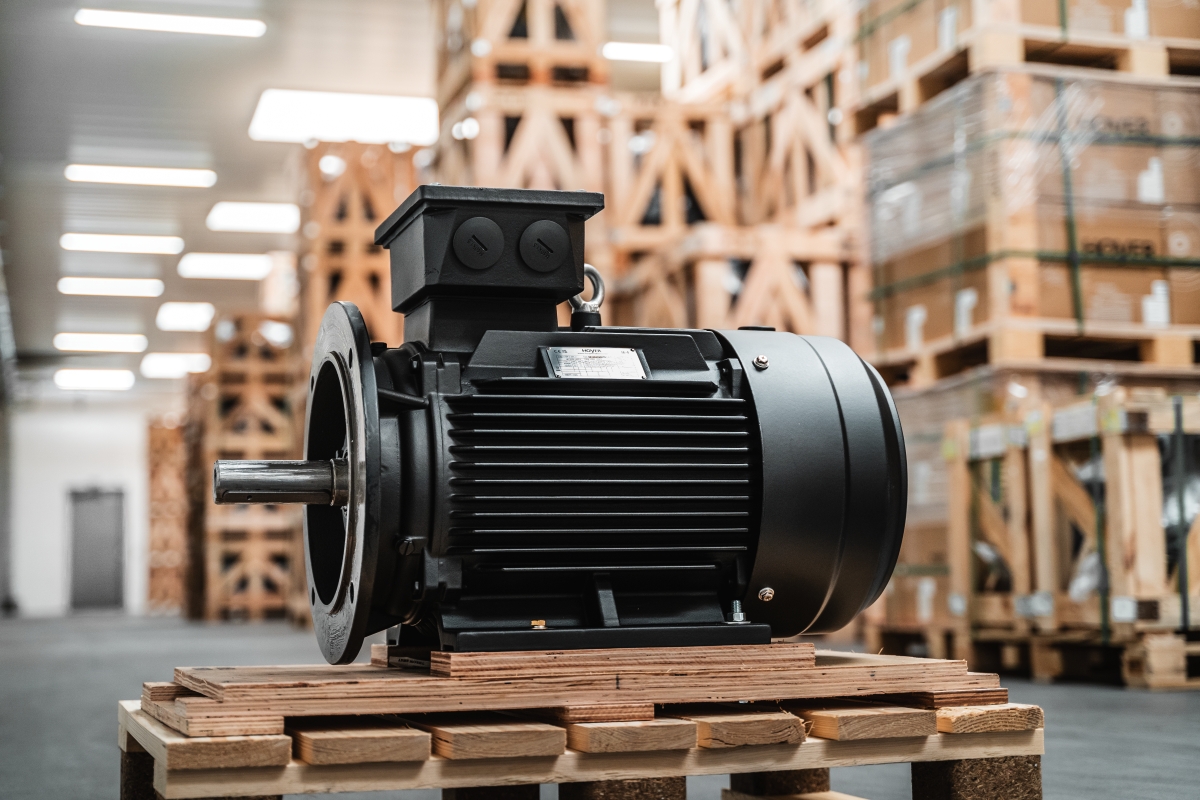
Frame Sizes: IEC 160 – IEC 355 (Power Range: 11 kW – 375 kW)
Primary Applications: Marine cooling pumps, heavy ventilation blowers, hydraulic power units (HPUs), mine conveyors, and chemical process agitators.
Constructed with rigid gray cast iron (GG25/EN-GJL-250) endshields and frame housings, this series features IP55/IP56 sealing, oversized premium bearings (SKF or FAG), Class F/H insulation, and PTC thermistors integrated directly into the windings. Optimized for both Direct-On-Line (DOL) and Variable Frequency Drive (VFD) operation.
Get CatalogFrame Sizes: IEC 80 – IEC 132 (Power Range: 0.75 kW – 7.5 kW)
Primary Applications: HVAC equipment, light industrial machinery, marine auxiliary fans, packaging machinery, and portable hydraulic pumps.
Engineered for applications where weight saving and corrosion resistance are essential. Features detachable feet for multi-mount flexibility (B3, B5, B14, B35), top-mounted aluminum terminal boxes, and high-efficiency internal fan cooling (IC411).
Get Catalog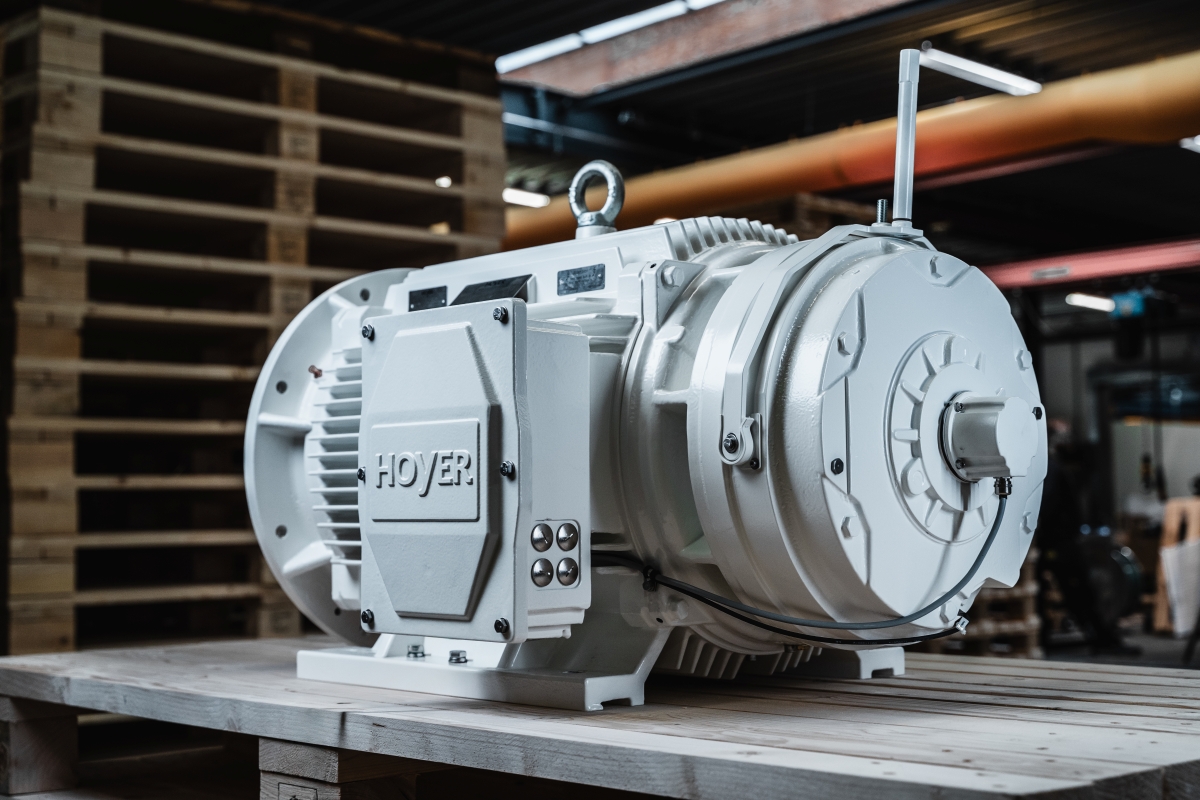
The following empirical performance metrics demonstrate the power density and operational parameters across representative Hoyer IE4 motor frames under IEC 60034-2-1 testing standard conditions:
| Frame Size | Output (kW) | Poles | Nominal Speed (RPM) | Full Load Efficiency (%) | 75% Load Efficiency (%) | Power Factor ($\cos\phi$) | Rated Current at 400V (A) |
|---|---|---|---|---|---|---|---|
| 160M | 11.0 | 4 | 1475 | 93.3% | 93.6% | 0.83 | 20.6 |
| 180L | 22.0 | 4 | 1480 | 94.5% | 94.7% | 0.85 | 40.3 |
| 225S | 37.0 | 4 | 1485 | 95.2% | 95.4% | 0.86 | 66.5 |
| 280M | 90.0 | 4 | 1488 | 96.1% | 96.2% | 0.87 | 158.0 |
| 315L | 160.0 | 4 | 1490 | 96.5% | 96.6% | 0.88 | 277.0 |
| 355L | 315.0 | 4 | 1492 | 96.8% | 96.9% | 0.89 | 538.0 |
When procuring industrial machinery, capital expenditure (CapEx) represents only the threshold investment. Life Cycle Costing (LCC) models mathematically confirm that high-efficiency IE4 motors deliver exceptional return on investment (ROI) through ongoing power tariff reductions.
The standard industry Life Cycle Cost ($LCC$) for an electric motor is expressed as:
LCC = C_ic + C_in + C_e + C_o + C_m + C_s + C_d
Consider a 110 kW pump system operating continuously ($S1$ continuous duty, 8,000 hours per year) in a processing plant with an average electricity tariff of $0.15/kWh$.
| Efficiency Class | Motor Efficiency Level ($\eta$) | Annual Energy Consumption (kWh) | Annual Operating Cost ($) | 10-Year Cumulative Energy Cost ($) |
|---|---|---|---|---|
| IE2 (High Efficiency) | 94.3% | 933,191 kWh | $139,978 | $1,399,780 |
| IE3 (Premium Efficiency) | 95.4% | 922,431 kWh | $138,364 | $1,383,640 |
| IE4 (Super Premium Efficiency) | 96.3% | 913,810 kWh | $137,071 | $1,370,710 |
Financial Takeaway: Upgrading from an IE3 motor to a Hoyer IE4 motor yields an annual energy savings of $1,293 per motor unit. Upgrading from an legacy IE2 unit yields $2,907 in annual direct energy savings. Given the typical price premium of an IE4 motor over IE3, the full payback period is frequently achieved within 9 to 14 months of operation. Over a 10 to 15-year service life, the net savings exceed the original motor purchase price by several hundred percent.
Global procurement teams must navigate evolving regulatory frameworks, changing supply chain dynamics, and technological transitions when specifying rotating electrical equipment for future industrial installations.
The European Union's Ecodesign Regulation (EU) 2019/1781 mandated IE4 standards for specific 3-phase motors between 75 kW and 375 kW. Global jurisdictions including China (GB 18613-2020), the UK, and North America are expanding efficiency minimums, making IE4 the default specification for continuous operations.
Enterprise procurement departments are tasked with reducing Scope 2 indirect carbon emissions. Standardizing on IE4 electric motors directly supports corporate ESG reporting targets by lowering overall megawatt-hour consumption per ton of production output.
Modern IE4 motor procurement increasingly specifies factory-fitted digital sensors (such as smart motor sensors monitoring 3-axis vibration, surface temperature, and acoustics) to enable predictive maintenance and prevent catastrophic un-planned outages.
Global logistics volatility has highlighted the vulnerability of extended lead times. Leading OEMs prefer motor suppliers that maintain substantial regional stock reserves (such as Hoyer's 70,000+ unit inventory) with localized modification capabilities.
Industrial operators are streamlining vendor lists, seeking strategic suppliers capable of managing the full equipment lifecycle—from initial engineering selection to rapid spare parts distribution and certified workshop overhaul services.
With the International Maritime Organization (IMO) imposing strict EEXI and CII metrics on ship owners, marine vessel auxiliaries (pumps, ventilation, thrusters) are aggressively retrofitting to IE4 marine-certified electric motors to achieve compliance.
Engineers and motor manufacturers continue to push the boundaries of magnetics, material science, and motor topology. Understanding these technical developments allows equipment designers to choose the optimal architecture for their specific system requirements.
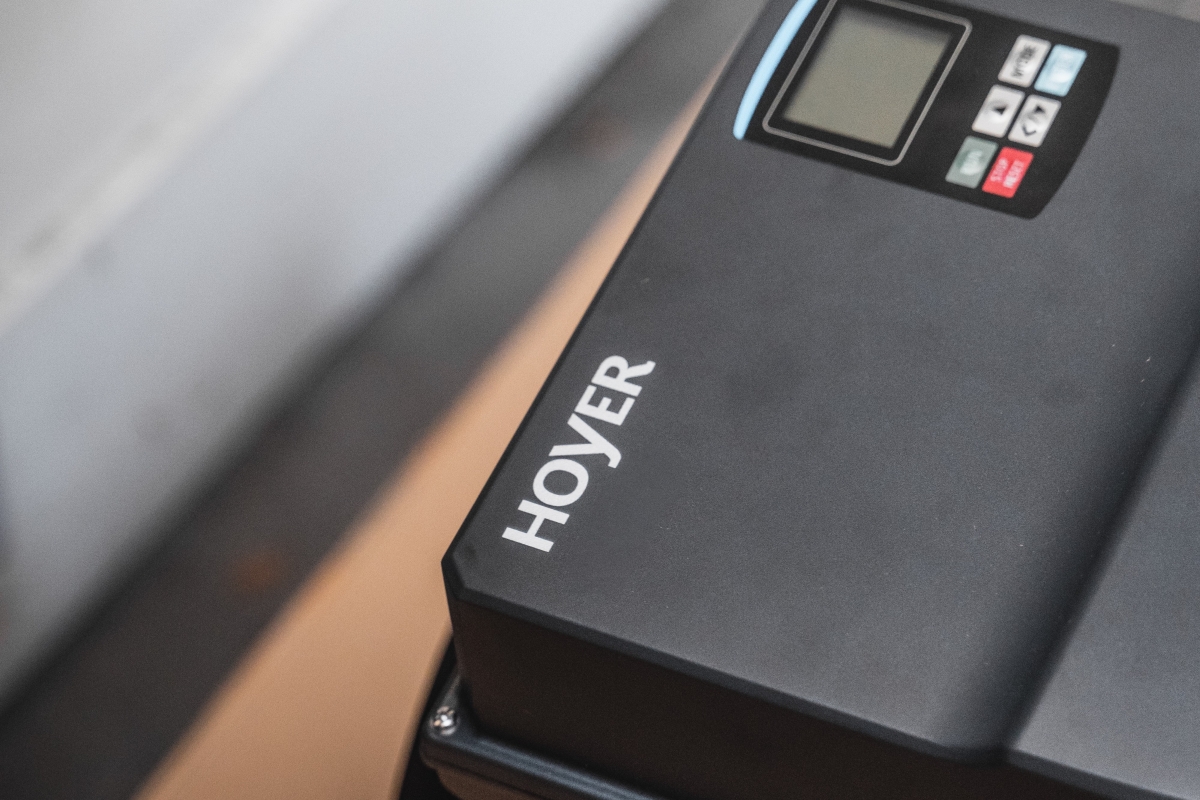
Achieving IE4 and ultra-premium IE5 performance levels is currently realized via three core motor technologies:
As variable speed applications proliferate, IE4 motors are frequently paired with modern Variable Frequency Converters (VFDs). High dv/dt voltage spikes from fast-switching IGBT or SiC inverters can induce severe stress on motor stator insulation. Hoyer IE4 motors incorporate reinforced phase isolation and vacuum pressure impregnated (VPI) Class H resin systems, complemented by insulated non-drive end (NDE) bearings on frame sizes 280 and above to eliminate harmful micro-bearing fluting currents.
Below are expert responses to common technical inquiries raised by procurement officers, OEM design engineers, and facility managers when evaluating IE4 motor solutions.
While nominal full-load efficiency rating differences between IE3 and IE4 typically range between 1.0% and 2.5%, the critical advantage of Hoyer IE4 electric motors lies in their flat efficiency curve. Under partial load operating conditions (50% to 75% of rated load—where most industrial pumps and fans spend the majority of their operational hours), standard IE3 motors experience efficiency drop-offs, whereas IE4 motors maintain near-peak efficiency. This extended sweet-spot yields substantially higher real-world energy savings than static full-load specs suggest.
In the majority of ratings, Hoyer IE4 motors maintain strict adherence to IEC 60072-1 standardized frame dimensions (shaft height, foot hole distances, shaft diameter, and flange dimensions), allowing drop-in mechanical replacement for existing IE2 or IE3 motors. However, due to increased active material volume (more copper and longer lamination stacks), some high-power output ratings may utilize the next larger IEC frame size. Our engineering team provides 3D CAD models and dimension verification prior to procurement.
VFDs introduce rapid PWM (Pulse Width Modulation) voltage switching spikes (high dv/dt), which can induce dielectric stress on winding insulation and generate shaft voltages that damage motor bearings. Hoyer IE4 motors feature premium Class H insulation wire, reinforced inter-phase insulation, VPI resin treatment, and insulated NDE bearings (standard on frame size 280 and above) to ensure reliable operation under aggressive VFD switching frequencies.
Hoyer Motors has over 50 years of marine heritage. Our IE4 marine electric motors can be issued with type approval or individual product certificate (IPC) documentation from all major IACS classification societies, including DNV, ABS, Lloyds Register (LR), Bureau Veritas (BV), RINA, and ClassNK. Marine modifications include marine-grade painting systems (C4/C5 offshore corrosion ratings), anti-condensation heaters, and special shaft sealing (IP56/IP66).
Because IE4 induction motors have lower stator resistance and higher magnetic flux density, their starting current ratio ($I_A/I_N$) and inrush currents can be slightly higher than older IE2 or standard motors (often ranging between 7.0 to 9.0 times nominal current). Electrical system designers should verify breaker protection settings, thermal relays, and contactor sizing when performing direct-on-line (DOL) retrofits, or consider soft starters / VFDs.
Aluminum frames offer significant weight savings (20–30% lighter) and high thermal dissipation for small-to-medium power requirements (IEC 80 to 132), making them ideal for mobile equipment, HVAC blowers, and weight-sensitive marine topsides. Cast iron frames (IEC 160 to 355) provide superior mechanical rigidity, structural dampening against vibration, and maximum resistance against aggressive industrial chemicals, heavy mining shock loads, and marine deck exposure.
Every Hoyer IE4 motor shipment includes complete technical documentation packages, comprising IEC 60034 test reports, CE declaration of conformity, RoHS/REACH compliance letters, 2D dimensional drawing sheets, and 3D STEP files. Optional documentation includes factory routine test reports, vibration spectrum analysis, noise test certificates, and marine classification society inspection certificates.
With over 70,000 motors maintained in stock across our European and Asian logistics centers, standard IE4 motors are available for immediate dispatch. Customized modifications—such as custom shaft dimensions, special flange machining, SPM vibration studs, tropical insulation treatments, or marine class certification—are completed in-house within our fast-track workshop in 3 to 10 working days.
Hoyer Motors is part of the Hoyer VMS Group—a global one-stop supplier for power and motion solutions created by the union of Hoyer and VMS Group. We combine high-performance rotating electrical machinery with comprehensive engineering services across the full equipment lifecycle.
Extensive warehousing in Hadsten (Denmark) and Ningbo (China) eliminates production downtime and protects your OEM delivery schedules from supply chain disruption.
Dedicated test benches, customized machining capabilities, paint booths, and certified QA engineers ensure every motor is tailored and verified to your exact technical datasheet.
From initial drive specification and energy efficiency audit to rapid emergency MRO service and field repair, our technical specialists operate 24/7/365 worldwide.